Why Your Texas Foundation Is Sinking (And How We Fix It for Good)
Welcome to Texas, where the stars are bright, the BBQ is legendary, and the earth beneath your feet is actively trying to destroy your home’s foundation.
If you own property anywhere from the Gulf Coast to the Panhandle, you have likely noticed that things aren’t exactly… level. Consequently, you have probably noticed that your driveway has developed a hairline fracture that is now a gaping canyon. Similarly, perhaps your front porch is slowly listing to the side like a stranded cruise ship. Furthermore, you may find that you can’t close your front door without lifting it first.
These aren’t just quirks of an older home. Instead, they are definitive symptoms of the unique geological war that expansive clay soil wages 24/7/365 under your concrete slab.
At Level Concrete Co., we do not simply patch cracks. We go to the root of the problem. Specifically, we specialize in bringing the earth under control. The definitive solution for stabilizing foundations in the Lone Star State is a specialized process we call soil stabilization.
Here is why your concrete is failing, and why this technique is the definitive game-changer you (and your foundation) need.
The Great Texas Squeeze: Why Clay Soils Move
The primary antagonist in this foundation thriller is a mineral called smectite, the main ingredient in “expansive clay.” Texas is loaded with it.
Clay is comprised of tiny, plate-like microscopic particles. When it rains (or you water your lawn too much), these particles love to absorb water. As they drink up moisture, they swell dramatically. Picture thousands of microscopic balloons expanding at once. When they swell, they exert an upwards pressure that is immense easily strong enough to lift, tilt, and crack your 100-ton concrete slab. This upward movement is called heave.
Then comes the dry season the infamous Texas summer droughts. The clay dries out and shrinks, leaving voids beneath your foundation where soil used to support it. Your concrete, having been lifted by heave, now drops into these voids, often at a tilt or in pieces. This drop is called settlement.
It’s the constant cycle of swell-shrink-swell-shrink that causes catastrophic failure. In any given Texas year, your clay soil can easily expand by 10 percent or more vertically.
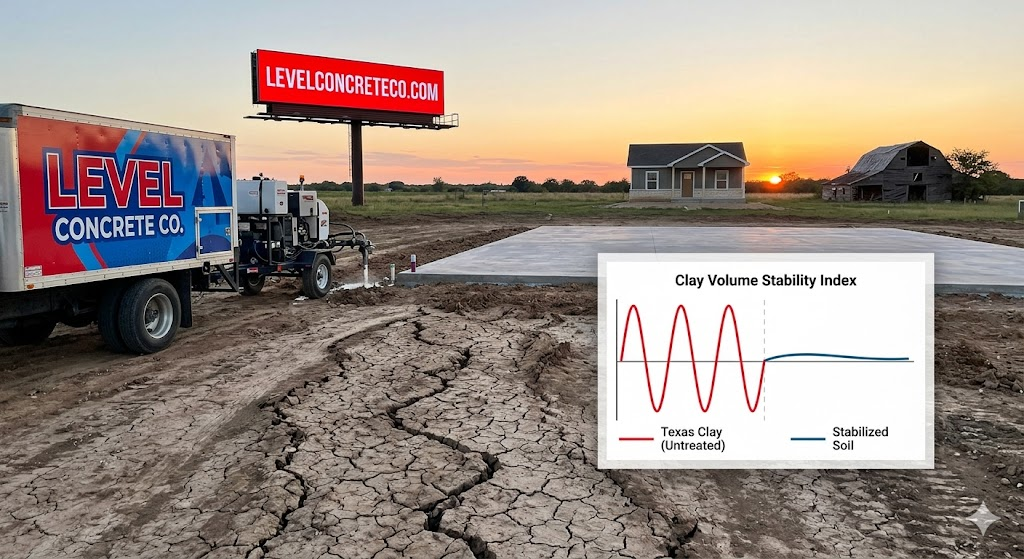
Visualize the Problem: Texas Clay (Untreated)
To understand how critical professional intervention is, compare the wild movement of untreated earth to the stability we achieve.
Figure 1: Visualizing the Problem of Texas Expansive Clay
Caption: Level Concrete Co.’s visualized soil analysis: a wildly fluctuating wave line (red) tracks the immense heave and settlement of Untreated Texas Clay, contrasted with the smooth, level stability (blue) achieved through stabilization.
The red graph in Figure 1 above is a visual representation of your concrete slab’s worst nightmare. It is not hypothetical; it is the measurable volume change of raw, expansive Texas clay over a weather cycle. Each peak is a heavy heave event; each valley is a major settlement drop. It’s a roller coaster that wrecks foundations.
By contrast, the blue line is the goal: flat-line stability. That is where we take the soil before we level your concrete.
Why Leveling Alone is Not Enough
A common question we hear is: “If my concrete is already settled, can’t you just inject some polyurethane foam to lift it back up?”
The answer is yes, we can but it might not stay there.
Standard concrete leveling (mudjacking or poly-lifting) is fantastic for lifting settled concrete voids and making things pretty today. But if your underlying clay soil is still active if it is still capable of swelling when the rain returns next winter the movement will restart. The very soil you just leveled can heave again, pushing up your leveled concrete and the lifting material.
Leveling addresses the settlement valley of Figure 1. It does nothing to address the heave peaks.
To fix your concrete for good, we must neutralize the heave. We must stabilize the ground. That’s why we offer soil stabilization as the primary, structural foundation fix.
Introducing Soil Stabilization: The Earth is Neutralized
This is not magic; it’s molecular engineering applied on a massive scale.
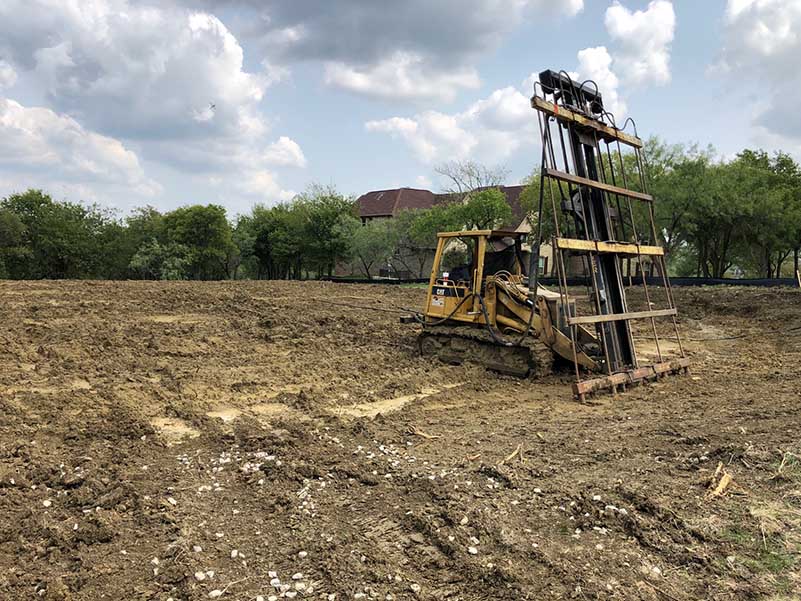
True soil stabilization involves the injection of specialized, non-hazardous chemical stabilizers deep into the expansive clay layers beneath your foundation.
This injection process physically alters the micro-structure of the clay particles. The chemistry of the stabilizer bonds permanently to the smectite molecules, changing their charge and surface structure. Crucially, it replaces the water molecules within the clay’s particle lattice with new, rigid chemical bonds.
The stabilized clay particles no longer swell when they encounter water. You can saturate that soil with a fire hose, and it will remain stable.
The Benefits of Chemical Soil Stabilization
- Permanent Swell/Shrink Neutralization: The molecular change is irreversible. The clay is ‘locked’ in its non-expansive state.
- Increased Load-Bearing Capacity: Stabilized soil becomes denser and stronger, providing better structural support for your slab.
- Prevents Future Settlement: By locking the moisture level, we prevent the soil from shrinking and creating voids.
- Minimally Invasive: The process uses small-diameter injection probes inserted around the exterior (or interior) of your slab, causing minimal disruption to your landscape.
- Environmentally Safe: The chemical compounds we use are non-toxic, non-hazardous, and safe for local water tables.
When we are finished with this process, that wild, red, jagged line in Figure 1 becomes the flat, smooth blue line. We have created a solid, immovable platform. Now, we can level any settled concrete with confidence, knowing the heave is gone forever.
Your Plan of Action: Call the Soil Authorities
Your home’s value is linked to its structural integrity. Therefore, you cannot afford to ignore foundation problems. Furthermore, you cannot afford to fix them with temporary patches that fail in two years.
Do not wait until your door won’t close, your walls are cracking, and your foundation repair quote has doubled. At Level Concrete Co., we are the soil and foundation authorities in Texas. Ultimately, we understand how to conquer clay.
Our process always starts with a precision analysis of your soil conditions and slab alignment. We utilize data, technology, and engineering—visualized in reports like Figure 1—to create a structural plan customized for your property.
Ready for Stability?
Take back control of your property’s value. Stop worrying about the rain. Schedule your free, no-obligation soil stabilization and foundation evaluation with Level Concrete Co. today.
Visit levelconcreteco.com now to get started. We are ready to make your Texas foundation truly level, once and for all.